Resort Fees Ban: What You Still Pay
You book a room for $189 a night. The confirmation page says $189. Then you reach the final screen and there is a line you never agreed to: a resort fee, tacked on after you have already typed in your card number. That is the exact scenario the resort fees ban was written to stop, and it has been the law for well over a year now, not a proposal still stuck in committee.
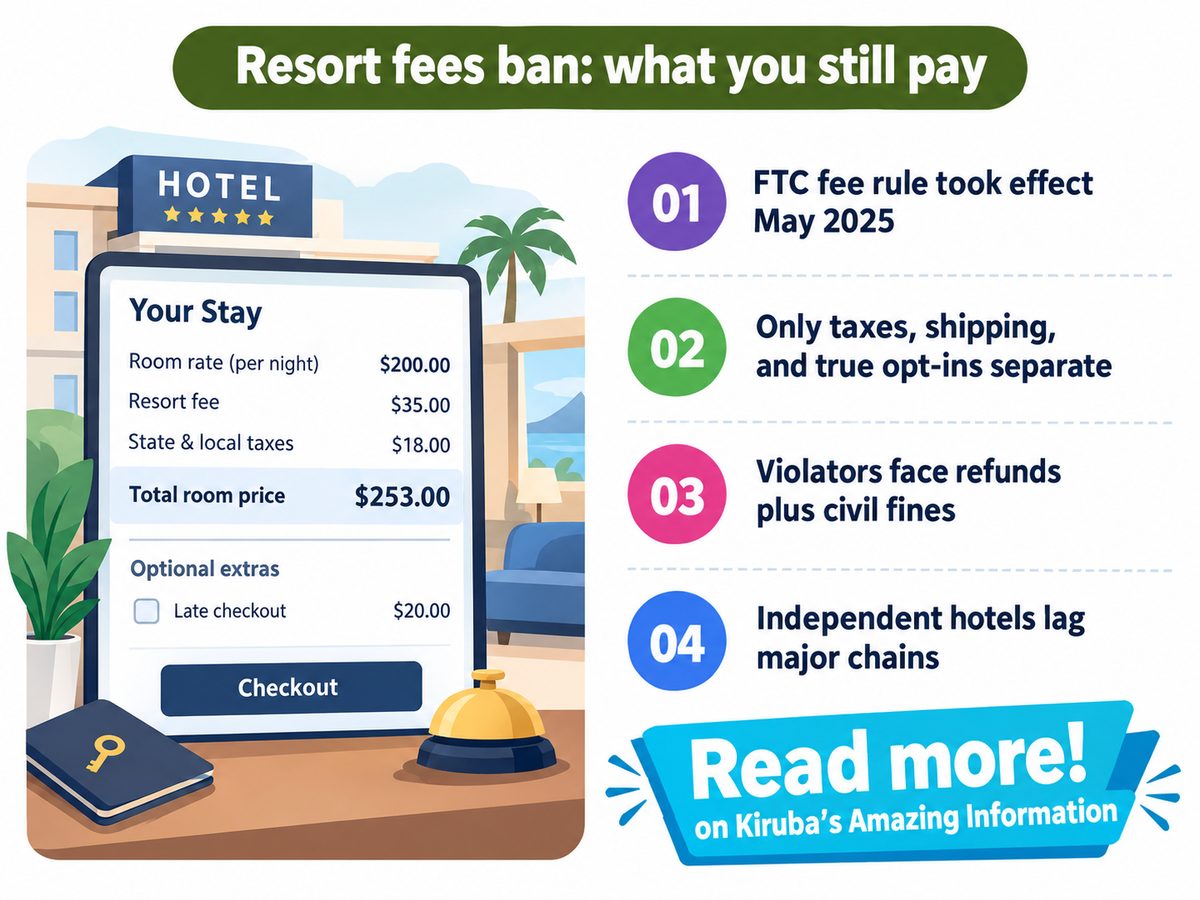
Ask the front desk why the price changed and you usually get a shrug, maybe a line about amenities. Push back with the actual rule and the fee often disappears right there at checkout, no manager, no argument. Assuming every extra charge is now illegal is where people get it wrong, and that mistake costs readers a winnable complaint more often than the fee itself does.
Key Takeaways: the FTC's resort fees ban makes hotels and ticket sellers show the full price up front, but three categories can still ride separately.
- Taxes, shipping, and genuinely optional add-ons are the only charges allowed off the sticker price.
- A resort or cleaning fee added at checkout breaks a rule with real refund and penalty teeth.
- Independent and boutique hotels lag the big chains on compliance, so check the price twice off-brand.
- Report a violation via ReportFraud.ftc.gov, a card chargeback, or your state attorney general.
What Does the Resort Fees Ban Actually Require?
The rule requires hotels, short-term rentals, and live-event ticket sellers to display one total price covering every fee except tax, shipping, and truly optional extras, before a shopper commits to buying.
The FTC's Rule on Unfair or Deceptive Fees took effect May 12, 2025, covering short-term lodging and live-event tickets (FTC.gov, Rule on Unfair or Deceptive Fees FAQ). Call it the junk fees rule if that is the name in the headlines; same regulation. Only three categories sit outside the advertised number: government taxes, shipping, and add-ons the buyer genuinely chooses. Resort fees, cleaning fees, and mandatory card-processing charges do not qualify; folding them in after the price is shown is the violation, not a pricing quirk.
Time the Rule's Been Live
16 months
Since May 2025, already enforceable
Projected Consumer Savings
$11 billion
FTC's decade estimate, unaudited
Sectors Covered
2
Hotel stays and live-event tickets
Chambers That Passed the Bill
1 of 2
House is done, Senate is not
That runway matters beyond press releases: the rule has outlived its first refund cycle, so attorneys general and card issuers now have precedent to cite instead of an untested regulation.
Eleven billion dollars is the FTC's own decade-long bet on this rule working. Whether it happens depends on inspectors, not on hotels suddenly discovering honesty.
I will push back on the common advice to just read the fine print before booking. That suited a decade of caveat-emptor pricing, not now: if the checkout price does not match the quote beyond tax and shipping, the hotel is wrong, not you. The same shift shows up in what a phone maker actually owes you just as clearly as at checkout.
The ticket side matters too. A $60 show that became $84 after service and facility charges was the textbook case behind this rule, the same push that ended blatant ticket junk fees on resale platforms. Sellers face the identical requirement hotels do: one number, shown early, that holds. India's banking regulator just told banks what customers can now demand on disclosure, the same fight over who shows the real number first.
Where Hidden Hotel Fees Still Show Up
Hidden hotel fees still show up wherever a charge gets renamed or delayed past the point a shopper already clicked buy, mostly at independent properties and rental booking flows built before the rule existed. Not every fee earns equal outrage though: some are baked in by law, some are still fair game if disclosed early.
| Category | Detail | Insight |
|---|---|---|
| Start Date | May 12, 2025 (FTC) | Already enforceable, not upcoming |
| Must Be Upfront | Resort, cleaning, mandatory processing fees | No longer a checkout surprise |
| Still Separate | Taxes, shipping, true opt-in extras | Legal add-ons, not violations |
| Penalty | 2 remedies: full refund plus civil fine | More than a warning letter |
| Weak Spot | Independent and boutique properties | Check twice off the big chains |
| Pending Bill | Hotel Fees Transparency Act, House-passed | Senate vote still open |
| Report Routes | 4: FTC, chargeback, state AG, review | Four ways to make it cost them |
| Still Fair Game | 3 examples: parking, ticket fees, rental surcharges | Fine if disclosed before you buy |
If a hotel or ticket seller lists a charge outside these three carve-outs, folding it into the sticker price is the rule, not a courtesy. The split comes straight from the FTC's own Rule on Unfair or Deceptive Fees FAQ, grouped here to show the divide at a glance.
Read down that table once and the pattern holds. Anything with mandatory attached to it belongs in the sticker price, anything genuinely optional does not, and the gap between those two words is where every dispute in this piece actually lives.
Can Hotels Still Charge a Cleaning Fee?
Yes, a cleaning fee is legal, but only when it is already folded into the total price shown before checkout; charged as a separate line after that point, it is exactly what the rule bans, not a gray area.
Vacation rentals are where this gets messy fastest. A host can still call something a cleaning fee and mean it honestly, a real one-time charge disclosed at the top of the listing, well, disclosed if the host actually bothered. The violation is not the fee's name, it is when it shows up. I would argue platforms carry more blame than individual hosts, since the booking flow still lets a price change after a guest has effectively committed.
This is not only a hotel story either. Payment processors have run the identical playbook for years, adding a charge only once you are deep into checkout; read what India's new payment fee rules actually change for the same disclosure fight playing out on a different rail entirely.
- A destination fee or amenity fee that appears only after you enter payment details.
- A quoted nightly rate on the search page that does not match the price at final checkout, beyond tax.
- A mandatory resort fee framed as optional with no real way to decline it.
- A ticket service fee added only after you have already selected seats.
Check your own situation before you file anything:
- Your card statement shows a higher total than the price you were quoted at search.
- The extra line appeared only after you had already entered payment details, not before.
- The property is independently run, not a major chain, and its listed price has not changed since last year.
Before you book anything this week, screenshot the quoted total and compare it to what you are actually charged at checkout. If the only differences are tax, shipping, or something you chose, you are fine. If not, you are citing a specific rule with a date and a screenshot, not filing a vague complaint. That is the difference between a shrug at the front desk and a fee actually coming off the bill.
No comments
Post a Comment