The request is one sentence: cancel my subscription. You joined in two taps, so you look for two taps on the way out. Instead the chat window hands you a phone number, and the agent offers a discount rather than the cancellation you asked for. Most people who push back now reach for the FTC's click to cancel rule. Wrong weapon. The rule is gone, and quoting it tells the company you stopped at the headline.
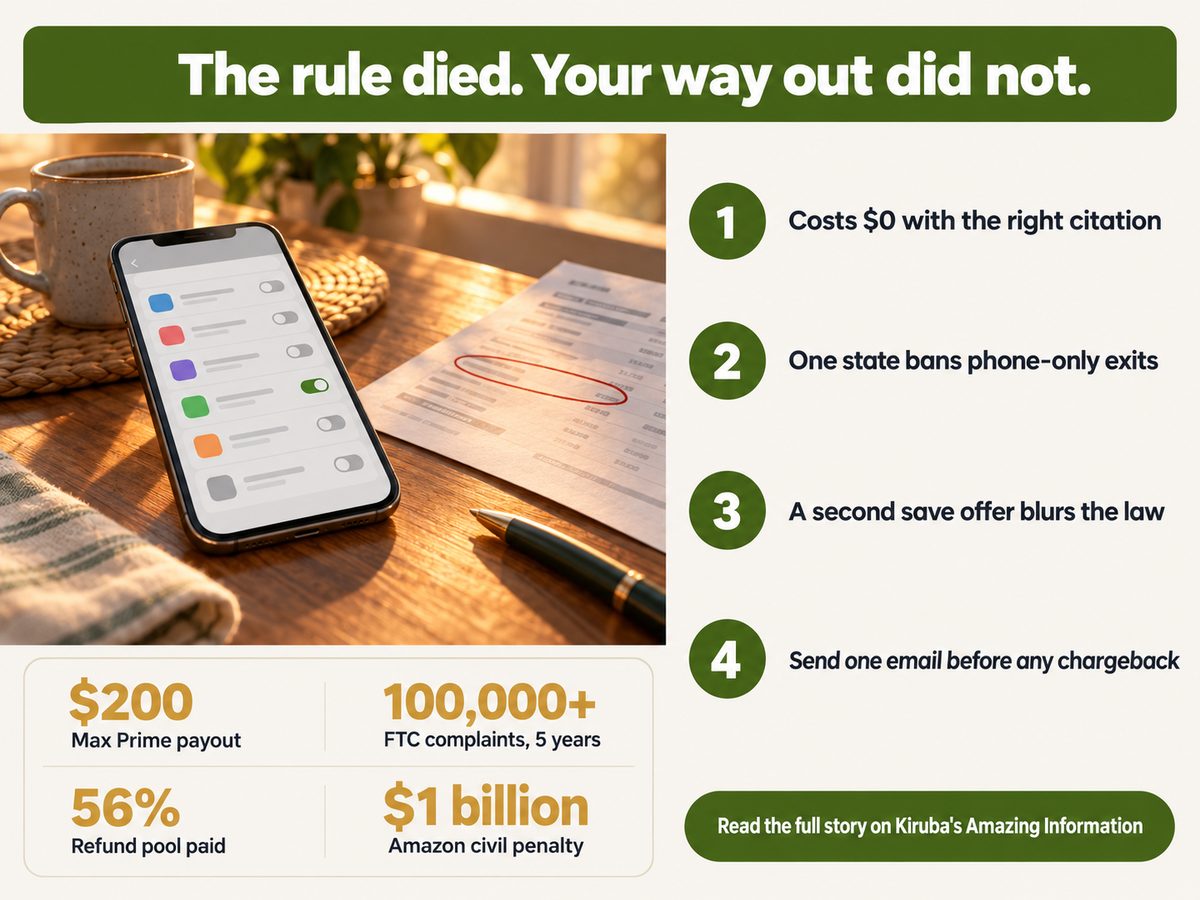
What works is older and duller: a 2010 federal statute plus your state's auto-renewal law. Together they already forced Amazon to pay refunds. Waiting for Washington did not work.
Key Takeaways
You can still force a clean cancellation, but cite ROSCA or your state's auto-renewal law, not the FTC rule a court threw out.
- An appeals court vacated the FTC's 2024 cancellation rule, and its replacement binds no company yet.
- ROSCA, still in force, requires a simple way to stop recurring charges. Quote that phrase.
- In California, a subscription bought online must be cancellable online.
- Amazon Prime refunds arrive automatically; anyone charging a fee to release one is a scammer.
What happened to the FTC click to cancel rule?
A federal appeals court vacated the FTC's 2024 cancellation rule in full in July 2025, days before its main provisions took effect, so no federal one-click requirement binds any subscription company today.
The Eighth Circuit never said easy cancellation was a bad idea. It said the FTC skipped a required preliminary regulatory analysis, so the fix is paperwork, and paperwork is slow. In March 2026 the FTC restarted with an advance notice of proposed rulemaking, a 30-day comment call on reviving the old rule's terms. That is the bottom rung. A proposed rule and a final rule still sit above it, so nothing new binds a company this year.
The law underneath never left. The Restore Online Shoppers' Confidence Act, or ROSCA, demands clear disclosure, informed consent and "a simple mechanism to stop recurring charges." In September 2025 the FTC announced a $2.5 billion settlement with Amazon over Prime sign-ups and cancellations, including a $1 billion civil penalty, with no cancellation rule in force. A cancellation maze was illegal before the 2024 rule and stays illegal after it.
The pattern repeats: compare what the FTC's junk-fee rule on resort fees actually covers, or what a phone maker owes you under India's right to repair push. Four figures decide whether pushing back is worth an evening, three from the FTC's September 17, 2026 Prime update and one from its March 2026 notice.
Top-Up Payment Deadline
Apr 2027
Extra money, no form needed
Max Prime Payout Each
$200
Worth checking your accounts
FTC Complaints, Five Years
100,000+
Your report adds real weight
Prime Benefits Used, Now Eligible
11-20 a year
Light users now qualify too
Take the complaint count. It is the evidence file for any future rule, and a free report at reportfraud.ftc.gov joins it. A company that stalls you is betting you won't file.
The rule died in court. The law behind it did not, and Amazon paid for a cancellation maze while no click-to-cancel rule existed.
Can a company make you call to cancel a subscription?
Under federal law a company may offer a phone line but cannot make quitting harder than a simple mechanism, and in California a plan bought online must be cancellable online, so phone-only exits often fail.
Which law to cite depends on where you live. The table sets ROSCA beside California's automatic renewal law, the most specific version, per Barnes & Thornburg's 2025 summary. If you live elsewhere, look up your own state's auto-renewal rules first.
| Dimension | ROSCA vs California | What it means for you |
|---|---|---|
| 💰 Cost to use | ROSCA $0, one FTC online report California $0, one written demand |
✅ Pushing back costs an evening, not cash |
| 🌍 Who it covers | ROSCA any US online sign-up California CA users, from July 1, 2025 |
✅ Most readers hold at least one lever |
| 🛠 How you quit | ROSCA any simple way to stop California same channel, 0 calls if online |
✅ Joined online means you leave online |
| 🧾 Consent | ROSCA informed consent before billing California express yes, kept 3 years |
⚠️ Ask them to produce the record |
| 📊 Reminders | ROSCA none required California every 12 months, with price |
❌ Outside some states, nobody warns you |
| 🏁 Best suited for | ROSCA any US account, any state California a California billing address |
🏁 Cite your state first, ROSCA always |
The shape is plain: federal law guarantees a way out, California specifies which way. My own reading of the same-channel rule, not a published figure, is that the phone calls a company can demand from a Californian who joined online number zero. Elsewhere, you argue over what "simple" means.
How do I get the Amazon Prime settlement refund?
You do not apply. The FTC's September 2026 payout update says eligible members are paid automatically, with no claim form. The cap began at $51, so a small first payment may not be your last. Lighter users qualify from October 1, and earlier recipients may get a $149 top-up if thresholds aren't met by February 2027.
Almost half the refund money has not gone out, so former Prime members should watch for a payment, not hunt for a claim site. Derived from the FTC's September 17, 2026 update: amount paid over the refund commitment, remainder by subtraction.
Subscription cancellation rights that still break down
Cancellation rights still break down wherever the law is vague, which mostly means endless retention offers and prepaid annual plans, and in those cases your leverage is a written record rather than a statute.
The honest grey area: nothing here settles whether a save offer you must decline twice is still a "simple mechanism." My view is one offer is fair and a loop is not (two might pass, if the second is a real price cut), but that is opinion, and the company's lawyer holds the other one.
Conventional advice says dispute the charge first. I'd reverse that: a card dispute claws back one payment but doesn't end the subscription. Cancel in writing, then dispute, the same written-demand move behind RBI's new mis-selling rules for bank customers.
- Prepaid annual plan: cancelling stops renewal, but a refund for unused months depends on your terms.
- A trial that turned paid without an express yes: in California, demand the money back.
- Phone-only exit after an online sign-up: screenshot every screen.
Check these against your own account
- You signed up online and the only exit is a phone line.
- Your billing address is in a state with an auto-renewal statute.
- A trial became paid and you never clearly said yes.
- You held Prime and have seen no payment notice.
So the decision is not whether to wait for the FTC. It is which law you cite first: your state's, with ROSCA behind it. This week, pick the subscription that fought you hardest and send one written cancellation quoting ROSCA's simple-mechanism language, plus your state statute if you have one. If the answer isn't yes, file the FTC report.