Right to Repair Laws: Who Owes You Parts
You ask the maker for a replacement screen. The reply is that parts go only to authorized shops, and the shop quotes a price that makes the old phone look like the better buy. Whether that refusal is lawful depends on the state you live in and the date your device was first sold. A right to repair law is the rule that settles it, and in 2026 the answer changes from one state to the next.
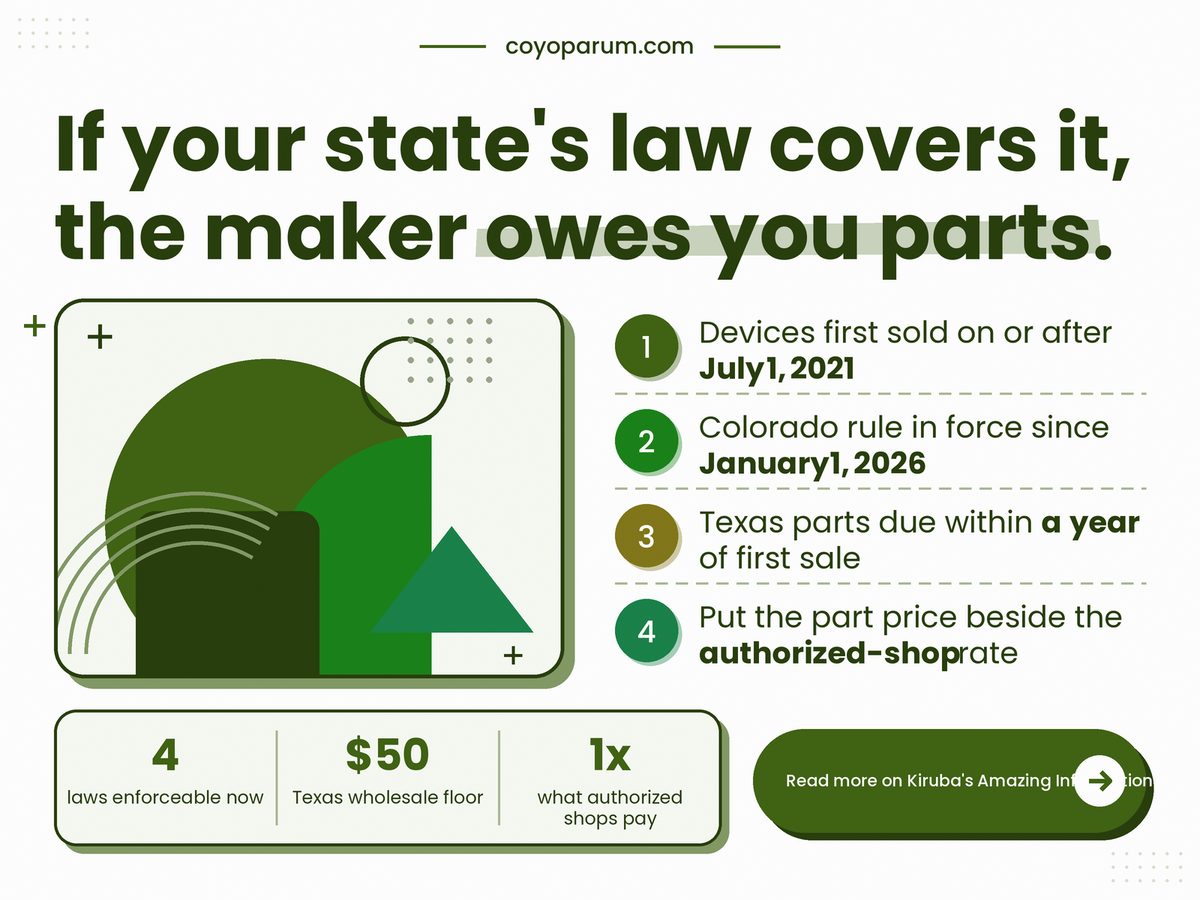
Key Takeaways (TL;DR)
Four states now require makers to supply parts or repair materials, and each law starts on its own date.
- Colorado's rule has applied since January 1, 2026, to devices first sold on or after July 1, 2021.
- Colorado restricts parts pairing in three specific ways, and none of them is an outright ban.
- Massachusetts's digital bill is still pending, so no state digital repair duty is in force there yet.
- Before you pay a shop or buy a replacement, check your state's date and your device's first-sale date.
Does Right to Repair Cover My Phone or Laptop?
Often yes, but only if the device was first sold after your state's cut-off date, and the receipt is the cheapest way to check that. Colorado and New York reach phones and laptops, while the Texas analysis does not confirm them, so check before assuming.
The cut-off runs from first sale, not from the day you bought it secondhand. Colorado's legislative summary of HB 24-1121 covers equipment first sold or used in the state on or after July 1, 2021, so a laptop first sold in 2020 falls outside the rule that took effect January 1, 2026. New York runs the same logic on an earlier clock: Proskauer's summary of its law applies it only to products first manufactured and first sold there on or after July 1, 2023. The same scope question shapes most consumer rules, and the airline refund rules after the 2025 rollback show it.
Four numbers decide most cases, and each one changes what you can ask for or what you pay. The day count and the law count are my own arithmetic. The Texas floor comes from the state's bill analysis, and the parts ceiling comes from PIRG's summary of Colorado's rule.
Days Colorado's Rule Has Run
293 days
Derived from the January 1, 2026 start
Texas Wholesale Floor
$50
Cheaper devices fall outside it
Laws Enforceable Now
4 laws
Derived count, pending bills excluded
Parts Price Ratio to Shop Price
1x
You pay what authorized shops pay
The cap only helps if you can see the shop rate, and a quote that omits it leaves the limit impossible to test. A rule that says no more than is easy to nod at and hard to check.
A parts price capped at the shop rate is worth nothing if you never see the quote.
Which States Have Right to Repair Laws?
Four states below have a law in force now, and each one starts on its own date, so the year you check matters as much as the state. Colorado, Connecticut, Texas and New York are enforceable today, while Massachusetts has only a pending digital bill.
| State | Rule and in-force date | What it means for you |
|---|---|---|
| ⚖️ Colorado | Parts on fair terms, from January 1, 2026 | Covers devices first sold after July 1, 2021 |
| ⚖️ Connecticut | Repair materials for owners, from July 1, 2026 | Same materials authorized shops already get |
| ⚖️ Texas | Parts within a year, from September 1, 2026 | Cheaper devices fall outside this rule |
| ⚖️ New York | Parts on fair terms, from July 1, 2023 | Only devices first sold there after that date |
Find your row, check the date, and the table settles most cases in one pass. A passed date means the right applies now, and a pending bill means nothing applies yet. The Connecticut and New York dates come from PIRG and Proskauer summaries rather than the statutes, so confirm them against the bill before you rely on them.
Eight of ten listed states cover electronics, so your first check is whether yours is one of them. Source: Morgan Lewis, June 2026, a secondary count that I did not check statute by statute.
Can a Manufacturer Refuse to Sell Me Parts?
No, a maker cannot refuse outright in the four states with a law in force, because each one requires parts or repair materials to be made available to independent shops and owners. The exact duties differ, and Texas gives makers a year from first sale.
Parts pairing ties a replacement part to the maker's own software, and it is the refusal that usually hides. Colorado bars it in three specific ways, including blocking a replacement part and showing misleading warnings about unidentified parts. It still allows pairing that records information or runs standalone biometric authentication.
Texas takes a narrower route. Its bill does not bar makers from requiring remote authorization or an internet connection before a part works, so a Texas shop may still hit that gate. My view is that this gap matters more than the headlines admit. For the India rules, which differ, read right to repair in India 2026: what a phone maker actually owes you.
- Ask the seller in writing whether a part needs online authorization before you pay.
- Texas gives a maker 30 days to cure after written notice, and only the attorney general can enforce the rule.
Conditions to check before you pay
- Your device's first sale falls after your state's cut-off, which the receipt usually shows.
- The seller will put the part price beside the authorized-shop price in writing.
Repair or replace is the decision, and parts come first. The same pattern shows up when a federal rule is vacated but other law still applies, as in what still forces a subscription company to let you quit. If your state's law reaches your device, the maker owes you parts or repair materials, so send one written request this week for the part, with its price beside the authorized-shop rate. Book the shop or buy the replacement only after that answer is in writing.
No comments
Post a Comment