Health Claim Rejected? Demand the Clause
Ask the insurance desk at an Indian hospital, on the day you're admitted, what share of the bill your policy will actually pay. You won't get a number. You'll get a pre-authorisation form, a polite nod and, days later at discharge, the first real answer: a deduction sheet, or a one-line note saying health claim rejected.
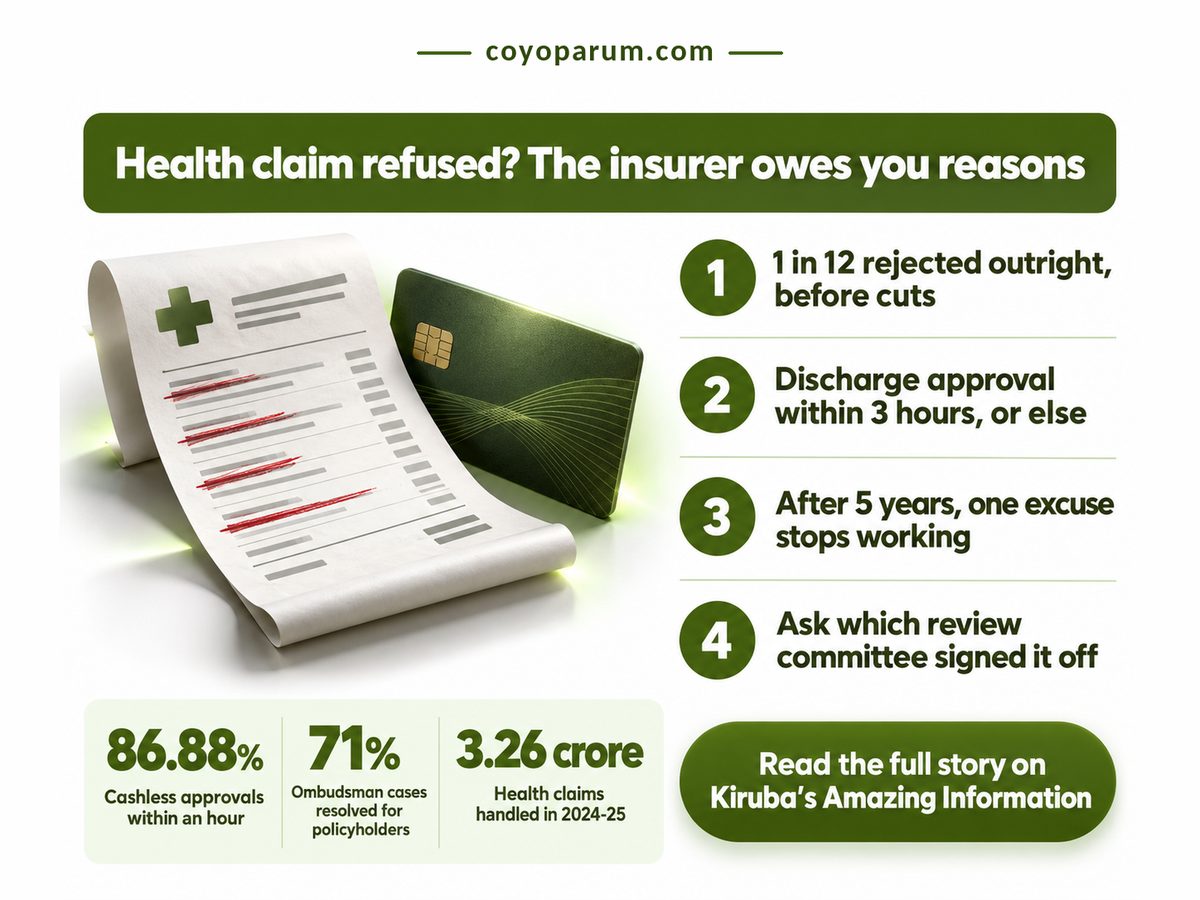
That up-front estimate is what policyholders keep asking for, and no rule gives it to them. What they won instead is narrower and more useful: IRDAI's Master Circular, in force since 31 July 2024, puts insurers on a clock and makes them explain every refusal in writing. The clock mostly works. The explanation is where people lose, because almost nobody demands it.
Key Takeaways
A refusal is only as strong as the clause it cites, so make the insurer name that clause and the committee that signed off.
- Insurers must decide cashless requests within an hour and give final approval within three hours of a discharge request; delay costs beyond that are theirs.
- A denial with no specific clause or committee approval breaks IRDAI's 2024 rules and is a complaint ground.
- Long, unbroken cover shuts the non-disclosure excuse, so never let a policy lapse while porting.
- Escalating is free: Bima Bharosa first, then the Insurance Ombudsman.
Why is the refusal letter your only real evidence?
Because IRDAI tracks how many health claims are refused but not why, the written reason in your own letter is the only record that can be checked against your policy wording and challenged.
Start with the scale. IRDAI's Annual Report for 2024-25, reported by Insurance Business Asia in July 2026, counts 3.26 crore health claims: 87% settled, 8% repudiated, 5% pending at year end. About one claim in 12 is refused outright, before anyone argues about partial cuts.
Now the gap. The Minister of State for Health told the Lok Sabha on 24 July 2026 that IRDAI does not collect data on why individual claims are denied, only the overall rate. Run those annual figures together and you get roughly 26 lakh refused claims in one year, none explained in any regulator table. That's my arithmetic, not IRDAI's (and it flatters the system, since a partial cut never counts as a refusal).
Here's where I part ways with the standard advice to read the policy carefully before you buy. Nobody can predict which exclusion a claims team will reach for. The better habit is the one RBI pushed onto banks, covered in our piece on what bank customers can now demand under RBI's mis-selling rules: make the seller put its reasoning on paper, then hold it there. The same logic runs through what a phone maker owes you under India's right to repair push.
Four numbers decide whether pushing back is worth your evening. The complaint figures are from the Council for Insurance Ombudsmen's 2024-25 report, via Insurance Business Asia; the waiting period is from the 29 May 2024 Master Circular, via Arthgyaan.
Moratorium on non-disclosure
60 months
After that, only fraud counts
Fee to approach the Ombudsman
Rs 0
No lawyer needed to file
Ombudsman complaints, 2024-25
53,184
You won't be a test case
Resolved for the policyholder
71%
Worth filing, never guaranteed
The moratorium is the one most people misread. Past it, an insurer cannot contest a claim for non-disclosure at purchase unless it shows fraud, and ported years count. A long-held policy refused over a hidden condition is the easiest letter to fight.
Seven in ten Ombudsman complaints end in the policyholder's favour, and filing costs nothing. The refusal letter opens the argument. It doesn't close it.
How long can cashless approval take at discharge?
Under IRDAI's 2024 Master Circular, an insurer has one hour to decide a cashless pre-authorisation and three hours from your discharge request to give final approval, and it bears the cost of any delay beyond that.
The surprise at discharge is rarely the wait. A Finance Ministry reply in the Lok Sabha on 1 December 2025, reported by Angel One and covering August 2024 to May 2025, shows both deadlines mostly met. What arrives late is the amount.
| Category | Detail | What it means |
|---|---|---|
| 🧾 Delay charges | Insurer pays past 3 hours | ✅ Refuse extra room-day charges |
| 💰 Payout estimate | No rule requires one | ❌ You learn the amount at discharge |
| ⏱ Cashless decision | Due in 1 hour; 86.88% on time | ⚠️ 1 in 8 wait longer; log the request time |
| ⏱ Final approval | Due in 3 hours; 96.69% on time | ✅ The wait is rarely the real fight |
| ⚖️ Written reasons | Specific clause must be cited | ✅ A vague letter is a complaint ground |
| ⚖️ Who can deny | Policy or 3-member committee | ✅ Ask in writing which one signed |
| 📊 Denial reasons | Not tracked; only overall rates | ❌ Your letter is the only record |
Read the right-hand column alone: the clock is enforced, the money is never predicted. Contest a long wait on the bill, and a deduction you don't understand on the clause.
If the insurer's two decisions together take more than four hours of your stay, the extra charges are its problem, not yours. Four hours is our own sum of the Master Circular's two deadlines, as summarised by Angel One.
Health claim rejected? Here is what still goes wrong
Even with the 2024 rules in force, three things go wrong after a refusal: no one estimates your payout in advance, cuts arrive at discharge, and the regulator cannot tell you how often a given excuse is used.
The payout estimate is the reform that would matter most, and nobody has delivered it. Insurers already hold the paperwork at pre-authorisation to tell a family what share the policy should cover, and whether a room-rent cap will trigger a proportionate deduction. That's the real test of the 2024 circular.
Escalate in order: Bima Bharosa, IRDAI's grievance portal, first, for a dated complaint number, then the Insurance Ombudsman. The same discipline works in any Indian money dispute, including fees charged on UPI payments after the August 2026 amendment. Watch your letter for these:
- A broad heading like not medically necessary, with no clause number.
- No committee named. Ask in writing which one approved it.
- A non-disclosure refusal on a policy held for years. Check your continuous cover dates.
- A gap in cover while porting. Renew first, then switch.
Act on this: tick each line against your claim
- My refusal letter quotes a clause number I can find in my policy wording.
- The letter names the committee that approved the denial.
- Final approval came within three hours of my discharge request.
- My cover has run unbroken, ported years included, past the moratorium.
The decision is simple: accept the deduction sheet, or contest it on paper. Contest it if the letter lacks a clause or a committee, if approval ran long, or if your cover is old enough to block a non-disclosure excuse. This week, write to your insurer asking which clause and which committee stand behind the cut, and file that same question on Bima Bharosa.
No comments
Post a Comment