Fake Black Friday Discount? 30-Day Check
A "-40%" tag will not say what it is measured from, and the word hiding that is "was". Under EU law the baseline is the lowest price of the previous 30 days, so a shop that lifts a price in October and "cuts" it on Black Friday has handed you a fake Black Friday discount. You pay for it. Ask the shop for last week's price and its page has no field for the answer. Ask for the "prior price" and you are quoting the law's own term.
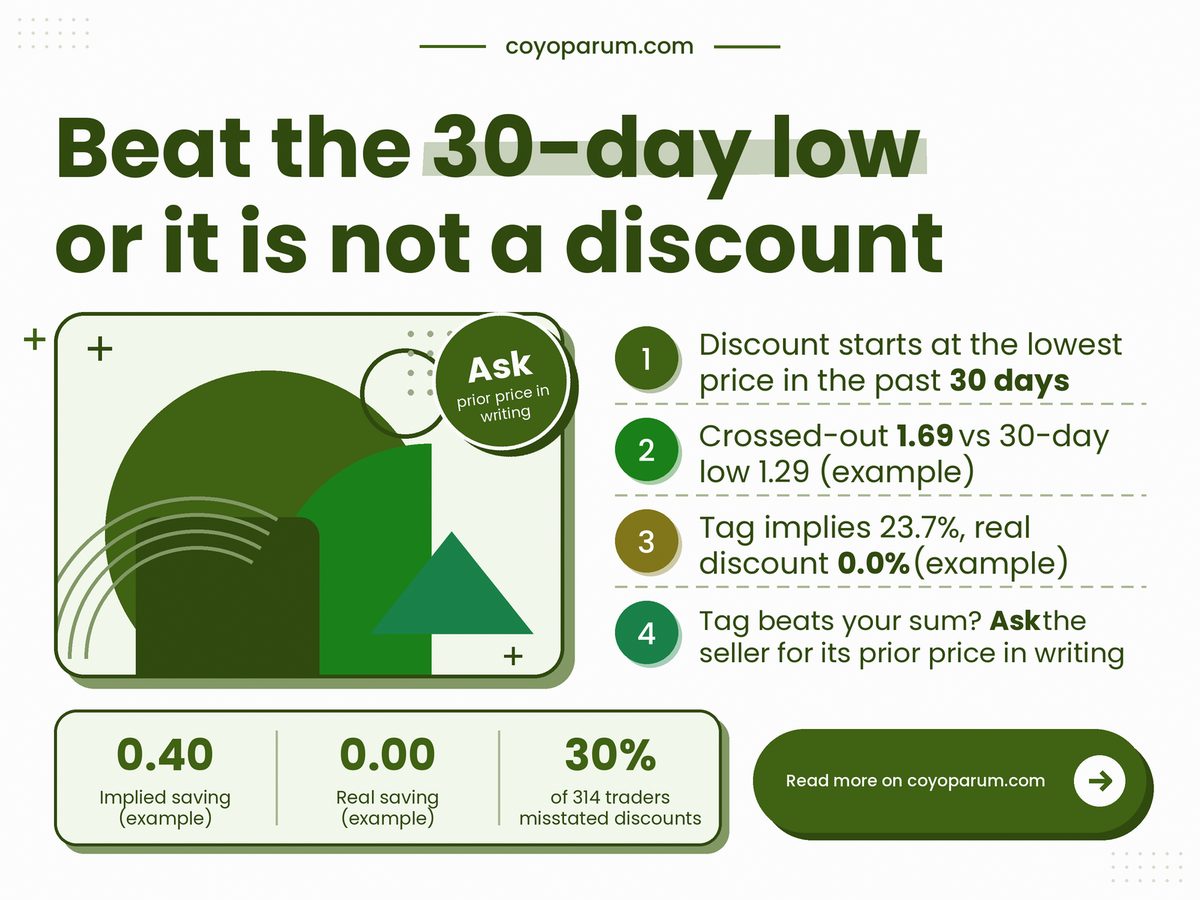
A Black Friday percentage is honest only if it starts from the lowest price of the past 30 days.
- Your check: (30-day low - sale price) / 30-day low. If the tag claims more, ask the seller for its prior price in writing.
- At or below 0% on that sum, there is no discount at all.
- Only EU law fixes the 30 days. UK and US rules name no day count, so there it is your yardstick.
Why does a -40% tag hide the number that matters?
Because the percentage is only as honest as its starting point, and a crossed-out price can be any figure the shop once chose, while the EU rule fixes the start at the lowest price of the past 30 days.
The rule is Article 6a of Directive 98/6/EC, added by Directive (EU) 2019/2161 and applied by member states from 28 May 2022. It defines the prior price as "the lowest price applied by the trader during a period of time not shorter than 30 days". In plain terms, the cheapest day of the past month is your starting line. The crossed-out price is not.
On 26 September 2024 the Court of Justice ruled in Case C-330/23, a complaint about how Aldi Süd advertised offers, that any price reduction must be set against that 30-day low, whether shown as a percentage or a promotional phrase. Traders may not raise a price just before announcing a cut.
Common advice says to compare with the original price. For EU shoppers that is outdated: the original can be any figure once printed. Refusals follow a pattern, as in our account of a refused Meta ad refund, and naming the clause is the lever, as in a rejected health claim in India.
How often is the baseline wrong? A sweep published on 26 March 2026 by the European Commission and national authorities checked 314 online traders in 23 EU countries plus Iceland and Norway and found that 30% displayed discounts incorrectly. Four figures frame the risk.
Lookback Window
30 days
Not last week’s price
Shops Misstating Discounts
30%
Roughly three shops in ten
Traders Checked
314
Across 25 European countries
Saving the Tag Implies
€0.40
Derived; the real saving is €0.00
The lookback is a floor, not a ceiling: the rule says "not shorter" than the stated length, so a longer price history only lowers the baseline and strengthens your case.
A €0.40 saving that vanishes the moment the baseline moves from the crossed-out price to the 30-day low: that is the whole trick.
How to spot a fake Black Friday discount before you pay
Find the item's lowest price over the past 30 days on a price tracker or the shop's own price history, then recompute the discount from that figure instead of from the crossed-out price.
Call it the Real discount check: (30-day low - sale price) / 30-day low, set against the tag's percentage. Take the average price over the month. No, wait: the lowest. Averages hide the cheap day.
Worked example: take the prices in the Court's press release, which report the consumers' association's figures, not a finding about Aldi. Assumptions: sale price 1.29, crossed-out price 1.69, 30-day low 1.29. Step one: the tag implies (1.69 - 1.29) / 1.69 = 23.7%. Step two: the 30-day basis gives (1.29 - 1.29) / 1.29 = 0.0%, a real saving of 0.00 against the 0.40 implied. Our arithmetic, not a court finding.
Run it backwards on a tag you meet. A "-40%" label is honest only if the 30-day low was at least 1.67 times the sale price, because 1 / (1 - 0.40) is 1.67. A "-20%" label needs 1.25 times. Our arithmetic, not a regulator's figure.
As of 24 November 2026, the rules depend on where the seller sits.
| Seller based in | Rule on prior price | What to do |
|---|---|---|
| ⚖️ EU shop | Lowest price in prior 30+ days | Recompute from the 30-day low |
| 🌍 UK shop | No day count; genuine-price test, Jul 2026 | Keep tracker screenshots as evidence |
| 🌍 US shop | No day count; "reasonably substantial" period | Use 30 days as your yardstick |
| ⏱ Under 30 days | Countries may allow under 30 days | Ask how long it has been listed |
| 💰 Perishables | Countries may set different rules | Ask which rule the shop follows |
Only the EU row hands you a number to quote back. In CMA v Emma Matratzen the High Court declined on 30 July 2026 to impose a 1:2 sales ratio, and 16 CFR 233.1 asks for a genuine former price. Our reading: 30 days is a fair yardstick everywhere, but only an EU seller owes it to you.
This graphic settles whether the tag can be trusted: 23.7% from the crossed-out price, 0.0% from the 30-day low. Our arithmetic from the press release prices.
What if the shop refuses to show its prior price?
Ask in writing for the prior price it applied in the previous 30 days; if it will not give one, screenshot the page, keep the order total, and report the listing to your national consumer authority.
In the 2026 sweep, 34% of traders showed price comparisons and six in ten of those did not clearly explain the reference price. Treat silence as your cue to ask, citing Article 6a. Keep dated screenshots of the tag and the basket.
Our view: a tracker screenshot plus the sweep's sentence, "the price of reference must be the lowest price applied in the past 30 days", gives the desk something to forward.
- Late fees: 10% of traders added fees late in checkout, so compare the final basket total.
- Basket extras: 36% tried adding optional items, four in ten without clear consent, so read every line.
Ask or walk when any of these is true
- A tracker shows the product below the crossed-out price at any point in the past month.
- The page shows a percentage or a "price highlight" and names no prior price.
- An Internet Archive snapshot of the page shows the product priced lower.
In the US, a card dispute runs on its own clock: see our explainer on the credit card dispute deadline.
This week, before any Black Friday basket, look up the product's lowest price of the past 30 days and run the Real discount check. If the tag's percentage is bigger than your result, ask the seller for its prior price in writing; at 0% or below, there is no discount. The call is wrong for products under 30 days old and perishables, and for sellers outside the EU, where 30 days is only a yardstick. Read the rule on EUR-Lex, and for another refund fight see airline refund rules after the 2025 rollback.
How we checked this
We read the Court of Justice press release on Case C-330/23 (26 September 2024), Directive (EU) 2019/2161 on EUR-Lex (18 December 2019), the CCPC release on the EU sweep (26 March 2026) and 16 CFR 233.1 on eCFR (current to 22 October 2026). The worked example takes its prices from the press release and its percentages from our arithmetic. No product was tested hands-on for this article. Last verified: 24 November 2026. Edited by Kiruba, reviewed after publication. Spotted something out of date? Tell us and we will correct it.
No comments
Post a Comment