Foreclosure Charges: The 3% Still Legal
You asked your bank to close a personal loan early. It agreed, then quoted a closing fee on everything you still owe, plus GST. You refused, because the headlines said the RBI had abolished foreclosure charges from January 2026. The bank refused right back, and on a fixed-rate loan it was within its rights. Here is what moves a lender, what bounces off, and the one sum that says whether to pay anyway.
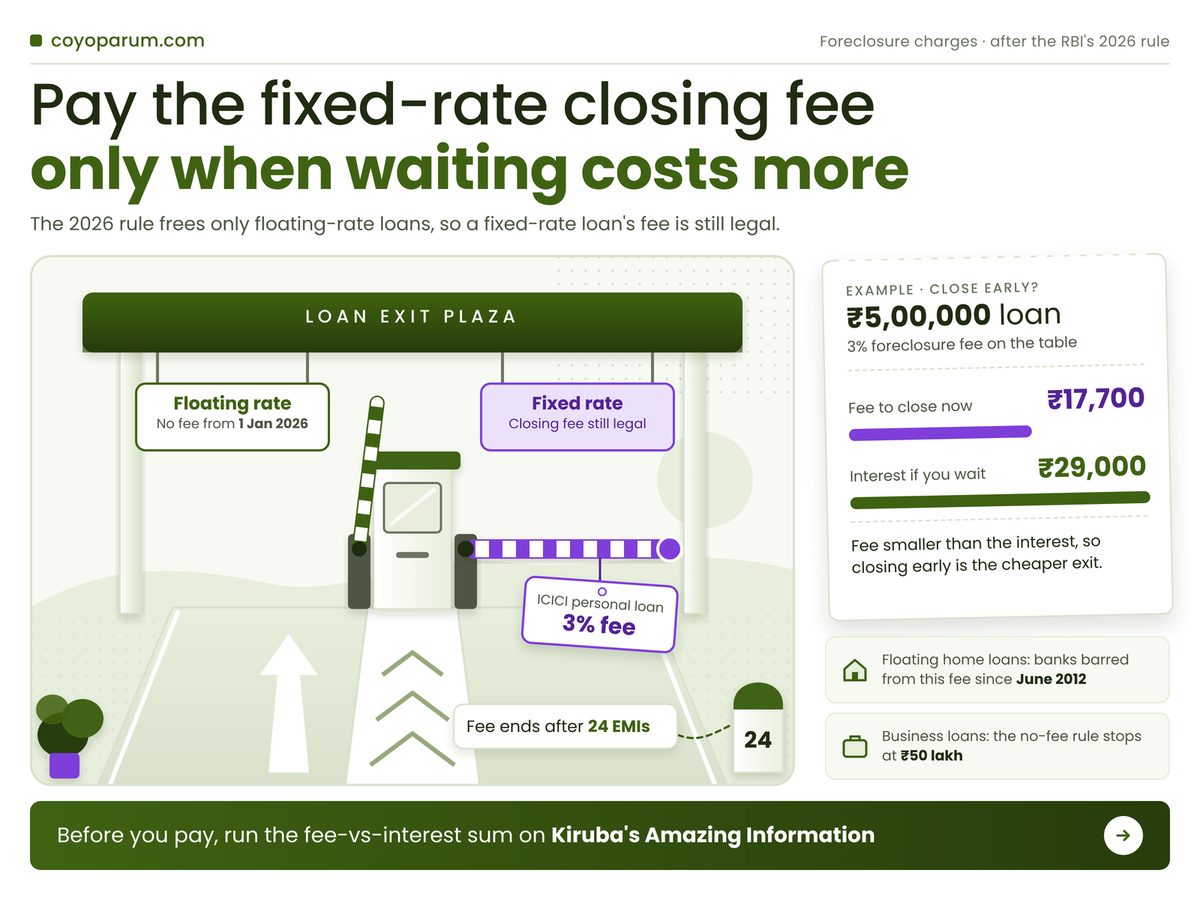
Key Takeaways: The RBI ended prepayment fees only on floating-rate loans sanctioned or renewed from 1 January 2026, so a fixed-rate personal loan can still carry a 3% closing fee.
- Check your Key Facts Statement for two lines: the interest type and the prepayment charge.
- From 2026, floating-rate personal and home loans carry no closing fee at any bank or NBFC.
- On a fixed-rate loan, pay the fee only when waiting would cost more in interest.
Why can a bank still charge foreclosure charges in 2026?
A bank can still charge because the RBI's July 2025 directions forbid the fee only on floating-rate loans sanctioned or renewed from 1 January 2026, leaving fixed-rate loans to each lender's board-approved policy.
The document is the Reserve Bank of India (Pre-payment Charges on Loans) Directions, 2025, RBI/2025-26/64, dated 2 July 2025. Paragraph 3 makes the sanction date the gatekeeper, so a loan signed in December 2025 and never renewed gains nothing. Every protected case in paragraph 5 shares one word: floating. Paragraph 6 leaves the rest to the lender, with one concession. A term-loan charge is worked on the amount you prepay, so a smaller part-payment draws a smaller fee.
This is where the headlines oversold it. Banks have been barred from charging individuals on floating-rate home loans since June 2012 and on all floating-rate term loans since May 2014, and an August 2019 RBI circular confirmed the bar covers non-business borrowing. If your floating home loan sits with a bank, 2026 changed little; the real gain went to business borrowers. As with the IRDAI rules that make a health insurer explain a rejected claim, quote the paragraph, not the press coverage.
Personal loans are where it bites. ICICI Bank's interest-rate page says the bank "offers a fixed Personal Loan interest rate", and its service-charges page, read on 30 October 2026, shows what leaving costs as of October 2026.
Time the Rule Has Run
10 months
Older loans sit outside it
ICICI Personal Loan Fee
3%
Of the principal still owed
Fee per ₹1 Lakh Closed
₹3,540
Derived, with GST added
EMIs Before the Fee Ends
24
Then closing early is free
The EMI count is the one borrowers miss. The fee does not taper; it switches off in the month you cross the line. And the page's hedge, "subject to applicable regulatory guidelines", promises nothing. Like the self-declared pledges in what a phone maker in India owes you under right-to-repair, it defers to the RBI text, which for a fixed-rate loan defers straight back to the bank.
The RBI did not ban the closing fee. It banned it on floating-rate loans signed from 2026; a fixed-rate loan signed last week is still fair game.
Which loans can still face prepayment charges?
Any fixed-rate loan can still be charged, and so can some larger business loans at smaller lenders, provided the fee was written into your sanction letter and Key Facts Statement before you signed.
Find your loan's row and do what the middle column says; the last row applies to everyone.
| If your loan is | Do this | Because |
|---|---|---|
| Floating, 2026 on | Refuse the fee in writing | Para 5(i): nil for personal use |
| Fixed rate | Price the fee against waiting | Para 6 leaves it to bank policy |
| Small bank, ₹50L+ | Ask for the policy rate | Business nil stops at ₹50 lakh |
| Bank-led closure | Pay no fee at all | Para 8 bars it when lenders ask |
| Any loan | Ask which KFS line applies | Para 9: undisclosed, unchargeable |
Most readers sit in the first two rows, split by one line of the Key Facts Statement (KFS), the interest type. If it says fixed, the question becomes whether paying is worth it.
Worked example: a fixed-rate ICICI personal loan, ₹5,00,000 outstanding after 18 EMIs. Assumptions: the 3% fee, GST at 18%, and the 11.60% mean personal-loan rate ICICI Bank's interest-rate page reports for July to September 2026. Closing now: ₹5,00,000 × 3% = ₹15,000, plus ₹2,700 GST, so ₹17,700. Waiting six EMIs for the fee-free month: roughly ₹5,00,000 × 11.60% ÷ 12 × 6 = ₹29,000 of interest, a little high because it uses the opening balance. Paying wins by about ₹11,300, unless your cash would earn above about 4.5% a year meanwhile. Check that break-even against your own deposit rate.
The sanction date matters too, because 2026 is the last of several widening bars.
Read your sanction year against this line: a floating-rate personal loan from a bank was fee-free long before 2026, so the newest date matters most if you borrowed for a business. Dates from RBI/2019-20/29 and the repeal list in RBI/2025-26/64.
What works when you push back, and what does not
What works is quoting the exact paragraph that fits your loan and asking for the KFS line; what fails is waving the headline at a fixed-rate loan or at a loan sanctioned before January 2026.
Disclosure is your strongest lever. Paragraphs 9 and 10 say a charge missing from the sanction letter, agreement or KFS cannot be levied, and a waived charge cannot be revived at closure, so your first email asks for the clause. For a 2026 floating loan, paragraph 5(iii) also protects a balance transfer from any fee. As with what still forces a company to let you cancel after the FTC rule died, a right is only as good as the step that enforces it.
One question stays open. The 2025 text repeals the 2012, 2014 and 2019 circulars from 1 January 2026, and we found no line on floating loans sanctioned under them. Our reading, and only that: a lender newly charging one would need the fee in your original terms, written while the ban stood. Escalate in writing, then use the RBI's complaint portal if the reply does not settle it. That advice fails if your loan was in a fixed phase when you closed it, so check the phase first.
- GST is added on top of any quoted percentage.
- Overdraft users avoid the closure charge by giving timely notice of non-renewal.
- A phone quote is not disclosure; get the figure in writing first.
Find these in your own papers before paying
- Your statement's EMI count, showing how far off the fee-free month is.
- A renewal letter dated on or after 1 January 2026.
- An offer email that promised a zero closing fee.
- A fixed phase on your loan that has already ended.
So, the decision. Pull your KFS this week and read the interest type and the prepayment charge. Floating and dated 2026 or later: refuse the fee in writing, quoting paragraph 5(i). Fixed: the fee is legal, so run the calculator above and pay only if waiting would cost more.
How we checked this
We read the RBI Pre-payment Charges on Loans Directions (2 July 2025) paragraph by paragraph, the RBI circular of 2 August 2019, and ICICI Bank's personal loan service charges and interest rate pages, both read on 30 October 2026. The worked example assumes ₹5,00,000 outstanding, 18 EMIs paid, the 3% fee, GST at 18% and an 11.60% rate, with interest figured on the opening balance. No product was tested hands-on for this article, and no loan was taken or closed. Last verified: 30 October 2026.
Edited by Kiruba, reviewed after publication. Spotted something out of date? Tell us and we will correct it.
No comments
Post a Comment