Gift Card Cash Out: Who Owes You Change
The back of most gift cards says "not redeemable for cash", and cashiers repeat it when you ask for the last few dollars. In California that word "not" has been wrong since 1 April 2026 for any card under $15, and holders of small leftovers pay for the error. Gift card cash out is a legal duty in a handful of states. Elsewhere it is a courtesy. So who owes you change depends on where you stand at the till.
The refusal is old. A 2014 CBS Sacramento undercover check, under California's lower line, found one store in four refusing: "There's no cash back on the gift cards" (as of 2014). The other three paid. Enforcement, an attorney told the station, meant small claims court or a district attorney. Thin.
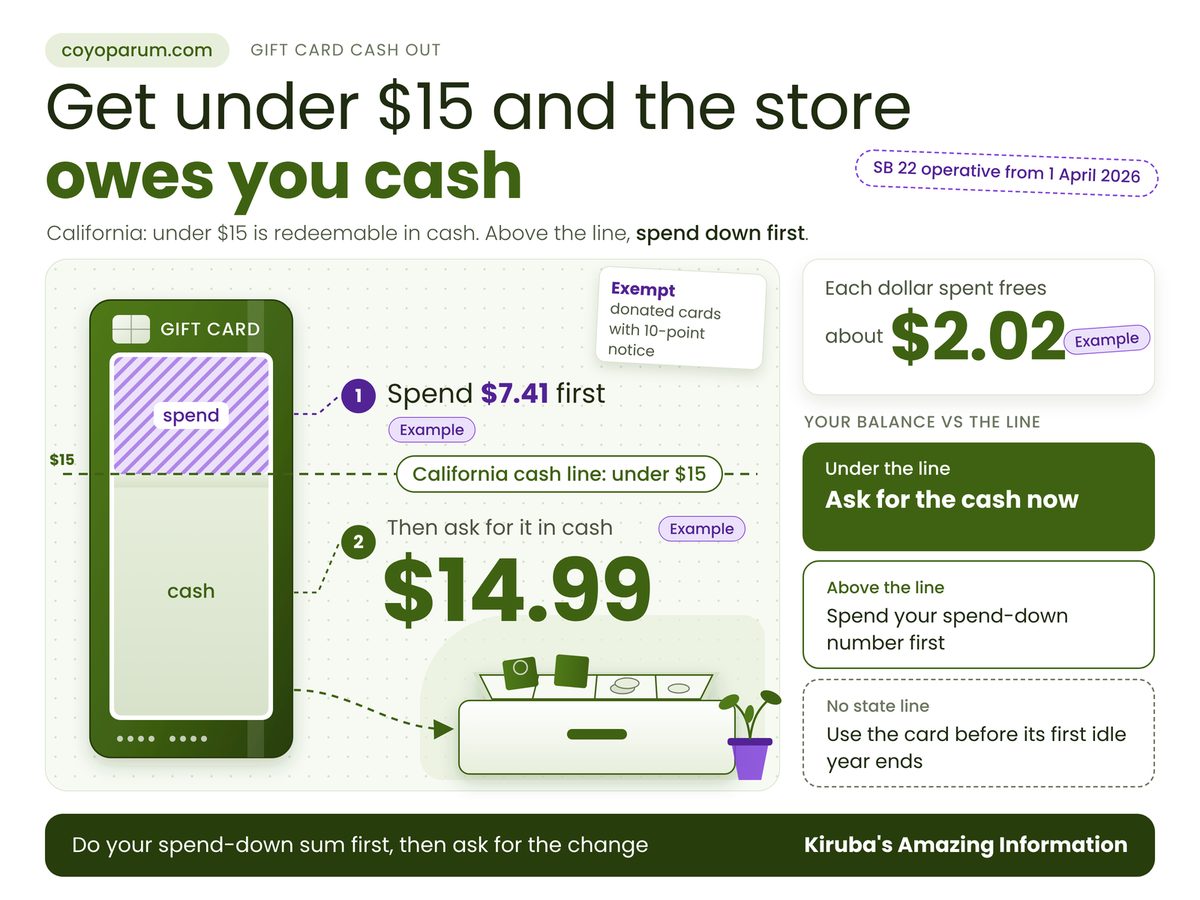
California must pay cash for any gift card balance under $15 since 1 April 2026; most states owe less, or nothing.
- Decision rule: under your state's line, ask for cash today; above it, spend down to one cent under the line, then ask.
- E-gift codes count under California's law, so an inbox balance qualifies.
- Donated cards printed with a 10-point "not redeemable for cash" notice are exempt.
- With no state line, one purchase a year stops federal inactivity fees.
Why does the till say no to cash?
The till says no because store policy follows the strictest state, while California's Civil Code now orders cash for any balance under $15 and most other states set a lower line or none.
SB 22, Chapter 207, was signed on 1 October 2025. From 1 April 2026, it says a card worth "less than fifteen dollars ($15) is redeemable in cash for its cash value." In plain words: $14.99 or less, and the store pays you. E-gift cards count. Dormancy fees are banned, bar one narrow exception. Buying cards in a doorbuster bundle today? Test it like a fake Black Friday discount. California's Delete Act platform for data brokers did the same to a polite request: made it a duty.
Four numbers decide what you can demand, drawn from SB 22, the federal rule at 12 CFR 205.20 and McDonald's cash-out table dated 1 April 2026.
Federal expiry floor
5 years
Old holiday cards still spend
California dormancy fee
$0
Idle cards keep full value
States with no cash-out row
36
Derived: a shop may refuse cash
Idle fees allowed elsewhere
1 a month
Only after a year unused
The fee card matters most. Outside California, a card that discloses an inactivity fee can start losing money after a full untouched year. One purchase resets the clock. A card you cannot cash wants a small purchase, not a drawer.
"No cash back" is a store's habit, not California law. Since April 2026, the statute wins for every small balance.
California is the generous end. Elsewhere, the question is whether your state draws a line at all.
Which states require gift card cash out?
Only a minority of states require a cash payout: McDonald's April 2026 table lists 14 states plus Puerto Rico, led by California at under $15, with most others under $5 and Rhode Island and Vermont under $1.
We checked three of its lines against statute on 27 November 2026. Washington's RCW 19.240.020 pays cash when the balance is "less than five dollars". Massachusetts pays once a non-reloadable card "has been redeemed for at least 90 per cent of its face value". Texas's line, from September 2015, covers in-person sales only, the Texas Tribune reported (as of 2015). Find your row.
| State | Cash-out line | What it means for you |
|---|---|---|
| ⚖️ California | Under $15, since 1 Apr 2026 | Spend down to $14.99, then ask |
| ⚖️ Washington | Under $5, on demand | Spend down to $4.99, then ask |
| ⚖️ Mass. | 90% spent, or reloadable at $5 | A $50 card pays out at $5 |
| ⚖️ Texas | Under $2.50, in person | Ask at a counter, not online |
| ⚖️ Unlisted | No cash duty on the list | Use it yearly to block fees |
Our arithmetic: on a $50 Massachusetts card, $45 must be spent before the last $5 becomes cash. One dollar in ten.
Worked example: a California card holding $22.40, last used six months ago, no fee (the state bans them). Step one: $22.40 is above the line, so the till owes nothing yet. Step two: your spend-down number is $22.40 minus $14.99, or $7.41. Step three: spend at least $7.41, then ask. Whatever is left comes back as cash, up to $14.99. Each dollar spent frees about $2.02 of cash.
A card bought this Black Friday cannot lose its money before November 2031, and in California any part under the line is cash from today. Our arithmetic: 2031 is five years from purchase under 12 CFR 205.20(e).
When can a store lawfully refuse cash?
A store can lawfully refuse cash when the card was donated to a charity and carries the 10-point disclaimer, when it is a free promotional or loyalty card, or when your state sets no cash-out line at all.
The charity exemption is narrow and printed. A donated card may refuse cash only if it states, in at least 10-point type, "the card is not redeemable for cash under California state law." No line, no exemption. Our reading: a cashier pointing at generic small print has the wrong sentence.
Federal protection has holes too. 12 CFR 205.20(b) leaves out loyalty and promotional cards, so a bonus card from a holiday purchase can expire within weeks. A card misrepresented at sale is a different fight, under the credit card dispute deadline that runs from your first statement.
Fees are capped too. Since 22 August 2010 the federal rule has allowed one only after "no activity" in "the one-year period", and "not more than one" a month. Use the card once a year and none can start. We disagree with the usual advice to save a card for something special. Outside California, waiting feeds the fees.
- A donated card with the 10-point notice may lawfully stay uncashed.
- Promotional and loyalty cards sit outside the federal floor.
- Massachusetts counts the share spent, not the balance left.
- A retailer in bankruptcy may stop honouring cards; our view: spend down early.
Ask for the cash at the till if all four hold
- Your balance sits below your state's line.
- The back carries no 10-point charity notice.
- You paid for it; it was not a free bonus.
- You are at a counter, as Texas requires.
Here is the call. If your balance is under your state's line, ask for the cash this week; if it is above, work out your spend-down number and spend that first. With no state line, make one purchase before the card's first idle year ends. The one check: the card's back for a charity notice, then the statute, for California SB 22's chaptered text. The call is wrong for donated or promotional cards, and for a retailer in bankruptcy. As with which repair parts a maker owes you, state law decides, not the shop.
How we checked this
We read the chaptered text of California SB 22 (Chapter 207, approved 1 October 2025), the federal gift-card rule at 12 CFR 205.20 (effective 22 August 2010) and McDonald's state cash-out table (dated 1 April 2026), and checked the Washington and Massachusetts lines against their statutes. The worked example assumes a $22.40 California balance, no fee and use within the past year. No product was tested hands-on for this article. Last verified: 27 November 2026.
Edited by Kiruba, reviewed after publication. Spotted something out of date? Tell us and we will correct it.
No comments
Post a Comment